Notes:
1) Water pumps mounted in the heads.
2) Water pumps mounted in the block.
3) Poured main bearings.
4) Insert type main bearings (Note: late 1936 model engine blocks were
usually marked LB*).
5) Did not have camshaft bearings
6) Aluminum heads. Truck engines for these years had cast iron heads. Note
that Ford sold replacement heads in cast iron
7) Cast iron heads.
General Information:
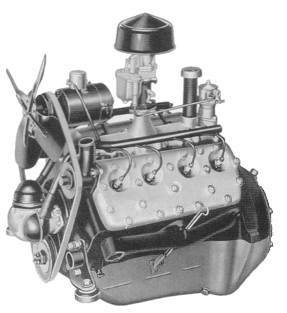
The early series flatheads were all 221 cubic (except the smaller 60hp
V8 covered in another section). All were cast with the bell housing
integral with the cylinder block. All had the "eggshell" (also
known as the "Diver's Helmet") shaped
distributor mounted to the front of the engine and driven directly off the
camshaft. Heads were attached to the cylinder block with hex nuts on
studs, which were threaded into the block. There were no Ford
factory-built oil filter systems on these engines. Early models used the
Detroit Lubricator carburetor. Stromberg "97" carbs were used from 1934 to 1938
at which point a change was made to the Ford designed "94" carburetor.
The engine cooling fan was mounted to the generator shaft from 1932
through 1938 (all models).
Ford
modified the block for 1935 to incorporate a new crankcase ventilation
system. These blocks are evident by the vertical tube located at the right
front corner in the valve chamber. The lower right front corner of the
block is changed to provide a passage for crankcase ventilation thru the
aforementioned tube. The oil pan was also modified to provide a vent at
the right front corner of the pan (a triangular shaped "box"
with an opening for venting). The differences are seen in this comparison
of early blocks (click
here).
* Ford changed the production of
main bearings from poured (babbitt) to the removable insert type
mid-stream in the 1936 model year. The newer (late '36 production) blocks were supposedly marked
with the letters "LB" on the block. Some blocks that had the new
style bearings did not receive this marking however. Ford did not use the
"LB" marking on the '37 or later blocks.
Early (1932-36) crankshafts had
main bearing journals of 1.999". In 1937 the journal size increased
to 2.399" Crank pin journals were 1.999" diameter from 1932 up.
Cranks were of the "short snout" type. For complete crank
bearing specs CLICK HERE.
Crankshafts weighed as follows:
1932-34 -
65.6 lbs
1935-36 - 60.0 lbs
1937-38 - 63.8 lbs
Ford
records indicate that the 21 stud engine was built up thru December 1937
for new vehicle production. However, the 21 stud engine continued to be
manufactured by Ford for other uses (service replacements or industrial
engines) until October 4, 1938.
Common
features for 1938 V8's were the large hole in the cylinder blocks (seen
with heads removed) between the 1st and 2nd cylinders and the 3rd and 4th
cylinders on each side. The intake manifold mounting surface was machined
flat (no raised area). There were core plugs (often called "freeze
plugs") in the oil pan rail. The main bearing caps used studs and
nuts to hold them down. There was a ridge (for the pencil resting test) at
the front of the block, behind the top of the timing gear cover. Ford
started to use the newer 24 stud engine for automobile production in a
mid-year change during the 1938 model year.