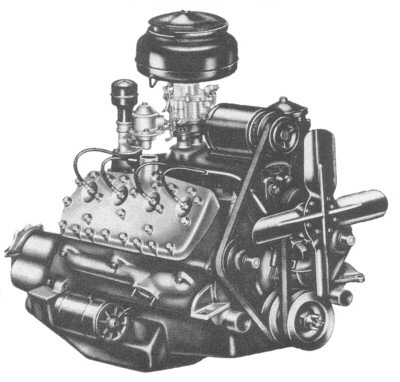
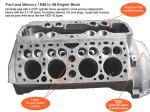
1946-48 (59A style) pictured
above
|
In 1938 Ford made new changes to
the flathead V8, the most obvious change being the use of 24 studs per
head instead of 21 as previously used. The engine underwent various other
changes as years passed.
In 1939 when the Mercury car line was introduced,
the engine's cylinder bore was opened up for a larger displacement in the
Mercury car. Changes to the distributor occurred in 1942 and again in
1946.
The cooling fan was driven by its own v-belt beginning with 1942
models. The engine continued to be cast with the upper bell housing integral
with the cylinder block assembly. In the post-war production both Ford and
Mercury versions had the larger bore (3-3/16").
Water outlets were in
the top center of each cylinder head for all 1938 to 48 motors. Water
pumps were mounted in the lower front corners of all blocks from this era,
and doubled as the front motor mounting pad.
|
| Year |
Displacement
(Cubic Inches) |
Bore
& Stroke
(Inches) |
Maximum
Brake HP |
Compression |
Head
Studs |
Notes |
| 1938 Ford |
221 |
3.0625 x 3.750 |
85 |
6.20:1 |
24 |
1,4 |
| 1939 Ford |
221 |
3.0625 x 3.750 |
85 |
6.20:1 |
24 |
1,4 |
| 1939 Mercury |
239 |
3.1875 x 3.750 |
95 |
6.30:1 |
24 |
1,4 |
| 1940 Ford |
221 |
3.0625 x 3.750 |
85 |
6.20:1 |
24 |
1,4 |
| 1940 Mercury |
239 |
3.1875 x 3.750 |
95 |
6.30:1 |
24 |
1,4 |
| 1941 Ford |
221 |
3.0625 x 3.750 |
90 |
6.20:1 |
24 |
1,4 |
| 1941 Mercury |
239 |
3.1875 x 3.750 |
100 |
6.60:1 |
24 |
1,4 |
| 1942 Ford |
221 |
3.0625 x 3.750 |
90 |
6.20:1 |
24 |
2,4,6 |
| 1942 Mercury |
239 |
3.1875 x 3.750 |
100 |
6.60:1 |
24 |
2,4,6 |
| 1946 Ford/Mercury |
239 |
3.1875 x 3.750 |
100 |
6.75:1 |
24 |
3,5,6 |
| 1947 Ford/Mercury |
239 |
3.1875 x 3.750 |
100 |
6.75:1 |
24 |
3,5,6 |
| 1948 Ford/Mercury |
239 |
3.1875 x 3.750 |
100 |
6.75:1 |
24 |
3,5,6 |
Notes:
1) Used the "Eggshell" or "Diver's
Helmet" style pre-war
distributor (1932 thru 1941)
2) Used the "Crab" or "Pancake" style distributor (1942 thru 1945 engines).
3) Used the postwar style (1946 thru 1948) round distributor (similar to
the crab style) with two bundled wire
harnesses off the cap.
4) Prewar "81A" and wartime "41A" style blocks.
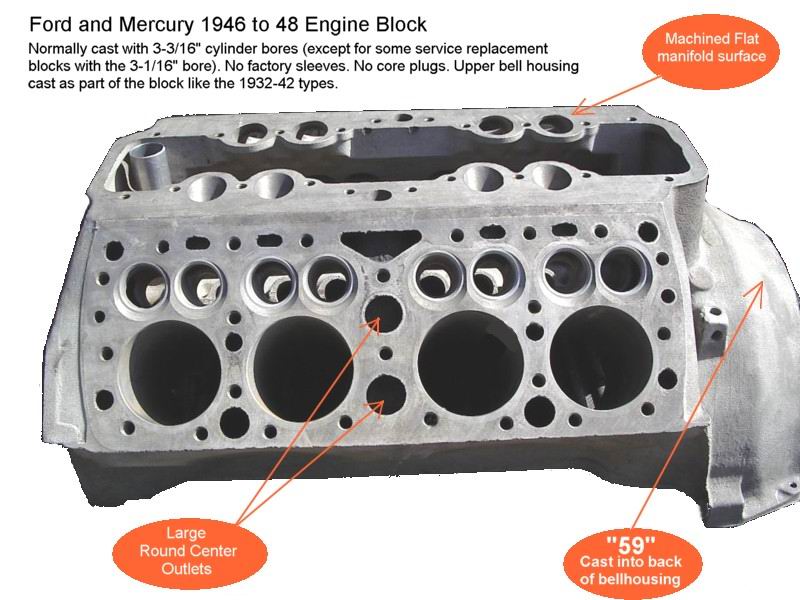
5) Postwar "59A" style blocks. These had the "59" cast
into the top of the bell housing. Note that some of the 59A style blocks were also
sold as replacement engines for pre-war 221 cubic inch cars and had the
3.0625" bore.
6) Had the two fan belt system (beginning with 1942 models) to drive the
accessories. One belt operated the water pumps and generator. The other
belt operated the cooling fan assembly. General Information
The integral cast-in bell housing
continued all the way through 1948 (except for the Ford trucks, which
received in 1948 the newer style 8RT engine with separate bell housing).
Refer to the 1949-53 engine details for the 1948 type truck V8 features. All engines during this period had
front, block-mounted water pumps (with wide belt pulleys), and twenty-four stud heads with
center-located water hose outlets. Original cylinder heads for 1938 to 1942 were generally marked with "81A"
for Ford or Mercury engines thru 1941; "81T" for truck
engines from 1938 to 1942; "41T" heads were sold for 85/90hp
trucks built from 1938 to 1942; "99T" for 100hp Ford
Truck and Mercury in 1939 to 1941;
and "29A" for Mercury in 1942.
Heads marked "59-A" or "59AB" were used
on all 90/100 hp (Ford & Mercury) engines from 1946 through 1948. The
59AB heads were sometimes used on earlier blocks in replacement rebuilds.
You can find the Ford part numbers (basic 6049 and 6050 number with
prefixes and suffixes) in the face of the heads and sometimes on the side
edge of the head next to the intake manifold. Additional
information
The
postwar cylinder blocks were also marked "59" (or "59A"
or "59L" or
"59X" or "59Y" or "59Z")
with raised letters cast into the top of the bell housing
part of the block. The Canadian version had a "C59" cast into
the same area. Another block assembly (the "41A" style) was
used to replace the "81A" style cylinder blocks, which were all
the 85/90hp engines with 3.0625" bore. The 1938 to 1940 blocks had four small "freeze plugs" (2 each side) in the
oil pan mounting surface. The 1941 (except for a short carryover) and later blocks did not have the
freeze plugs. These can be noted from outside an assembled engine by the
slight "bumps" in the side of the block casting, right at the
oil pan mounting surface. In mid 1938 Ford modified the engine for larger
diameter main bearings. For complete crankshaft bearing specs CLICK
HERE. The original engines from mid 1941 to final 1942 production
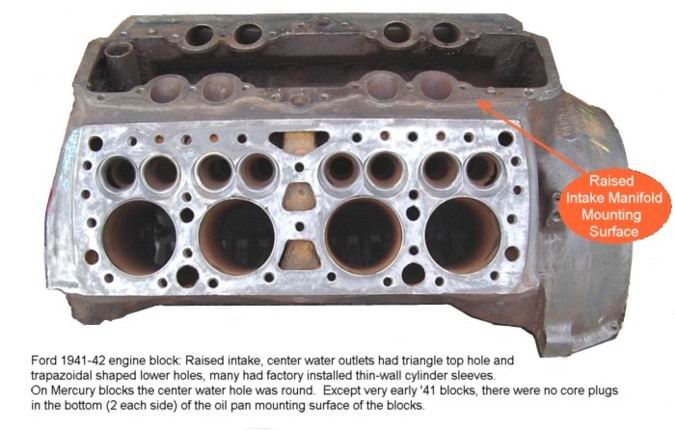
(when WWII ended auto production) had a raised intake manifold deck
surface. Prior to these engines, the entire manifold deck surface was
machined flat, right out to the edge of the cylinder deck. The postwar
engines seem to have returned to the practice of machining the intake deck
all flat again. The foundry would also place what were probably
"lot" or "production" numbers in the castings on all
blocks. These were usually a small group of letters and numbers cast on
the top of the bell housing....right next to the vertical surface of the
back of the block. Unfortunately, any records of these numbers are long
gone and they provide no clues as to the particulars of any engines.
Water
jacket holes in the top of the cylinder area of the block will tell you
what years the block may be:
1938
Blocks: Large triangular shaped holes between the center cylinder
bores
1939-42 Blocks: Three openings between the center cylinder bores:
top one is triangular;
center and bottom holes are trapazoidal (or keystone) shaped.
1945-48 Blocks: The three center openings: top one is triangular;
center and bottom holes are large round holes.
All
24 stud engines using cast iron heads were equipped with dome-top pistons
(in either aluminum or steel). Engines built through 1939 had a
pressed-on timing gear on the camshaft. Beginning in 1940 this gear was
bolted on to the camshaft. All engines up through 1948 had
"mushroom" style valve stem ends and split valve guides. Some
engines (including 59A style) had removable hardened valve seat inserts.
It's not uncommon for an early (pre 1946) engine to have the valve seats
installed by an engine rebuilder at some point in its life. As
for original paint colors, the Ford and Mercury engines through 1940 were
a dark green. Ford cars continued the color until 1942. Mercury engine had
a dark blue color from 1941 thru 1948. Postwar Ford engines were dark blue
thru 1948. Ford truck engines were generally the same as Ford cars during
the years of this group.
|